
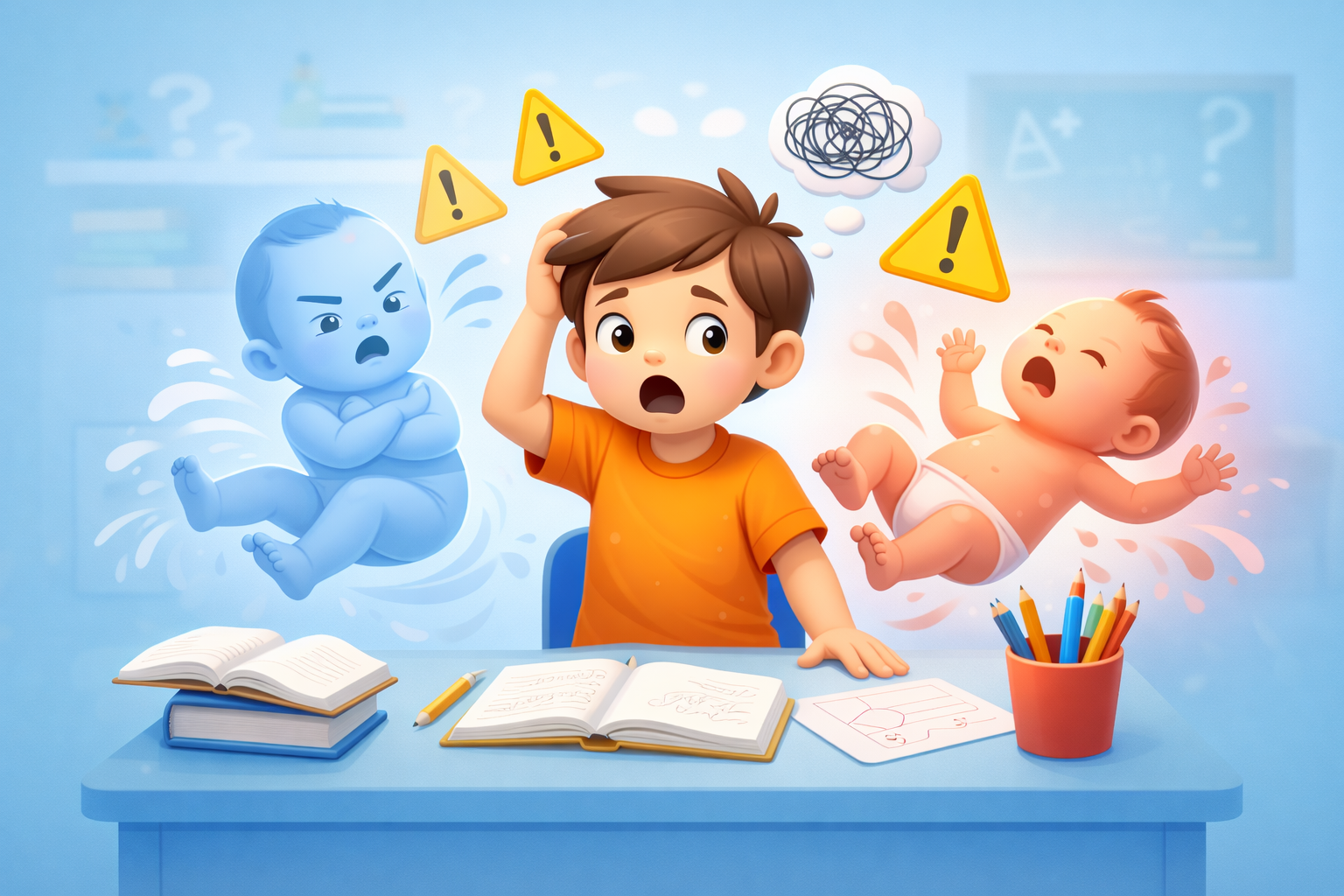

Have you ever wondered why your intelligent child struggles so much with simple tasks like sitting still, copying from the chalkboard, or riding a bike? You have tried tutoring, behavioral charts, and extra practice, but nothing seems to stick.
The answer might not be behavioral. It might be Reflexive.
We are diving into a topic that is often the “missing piece of the puzzle” for many families: Retained Primitive Reflexes.
Table of Contents
What Are Primitive Reflexes?
When a baby is born, their brain is not fully developed. To survive, nature equips them with a set of automatic movements called “Primitive Reflexes.” For example, if you stroke a newborn’s cheek, they automatically turn their head to suck (Rooting Reflex). If you place a finger in their palm, they grab it tight (Palmar Reflex).
These reflexes are supposed to be temporary. As the baby grows and starts to move voluntarily (rolling, crawling, walking), these reflexes should “integrate” or disappear, usually by age one. They are replaced by higher-level brain control.
The Problem: When They Don’t Go Away
Sometimes, due to trauma at birth, lack of “tummy time,” or skipped crawling stages, these reflexes do not disappear. They remain active in the body. This is called a Retained Reflex.
When a reflex is retained, the child’s brain has to work overtime just to keep their body under control. It is like trying to drive a car while the emergency brake is still on.
The 3 Most Common Culprits
1. The Moro Reflex (The Startle Reflex)
- What it is: The baby throws arms back when startled.
- If Retained: The child is in a constant state of “Fight or Flight.” They are hypersensitive.
- Signs:
- Hates loud noises or tags on clothes.
- Anxiety and mood swings.
- Motion sickness.
- Difficulty paying attention because they are scanning for “danger.”
2. The ATNR (Asymmetrical Tonic Neck Reflex)
- What it is: The “Fencer Pose.” When a baby turns their head to the side, the arm on that side extends, and the opposite arm bends.
- If Retained: The hand is tied to the head movement.
- Signs:
- Poor Handwriting: Every time they turn their head to look at the paper, their arm wants to extend involuntarily. They have to grip the pencil tightly to fight this.
- Trouble catching a ball.
- Difficulty riding a bike (turning the head makes the handlebars turn).
3. The STNR (Symmetrical Tonic Neck Reflex)
- What it is: Helps the baby get up on hands and knees. Head up = arms straight, legs bent. Head down = arms bent, legs straight.
- If Retained: The upper and lower body are stuck in a seesaw motion.
- Signs:
- “The Sloucher”: They lie on the desk while writing.
- “W-Sitting”: They sit on the floor with legs in a W shape.
- Messy eating.
Why Does This Affect School?
Imagine a child with a retained ATNR trying to copy notes from the board.
- They look up at the board (Head moves).
- Their arm involuntarily wants to move.
- They look down at the paper (Head moves).
- Their arm wants to move again.
Their brain is using 90% of its energy just to control their arm, leaving only 10% for learning math or spelling. They aren’t lazy; they are neurologically exhausted.
The Solution: Integration
The good news is that the brain is plastic. You can “retrain” the brain to integrate these reflexes through specific, repetitive movements.
- For Moro: “Starfish” exercises (curling up tight and opening wide).
- For ATNR: Lizard crawls or marching while turning the head side to side.
At Little Land, our therapists are trained to screen for these reflexes. If we suspect a retained reflex is holding your child back, we can design a play-based plan to help integrate it. Often, once the reflex is integrated, parents see a “miraculous” improvement in reading, writing, and emotional regulation.