
“Why won’t he share?” “Why does she ignore the other kids at the park?”
As parents, we are eager for our children to make friends. We envision them playing happily together, sharing toys, and building team spirit. So, when we see our 2-year-old snatching a toy or playing alone in a corner, we worry. Is something wrong socially?
Table of Contents
Relax. Social play is a skill, just like walking or reading. It develops in stages. Sociologist Mildred Parten identified 6 Stages of Play. Understanding these will help you manage your expectations and know how to support your child at each level.
Stage 1: Unoccupied Play (Birth – 3 Months)
The baby is just observing. They move their arms and legs, learning how their body moves. It doesn’t look like play, but it is the foundation.
Stage 2: Solitary Play (Birth – 2 Years)
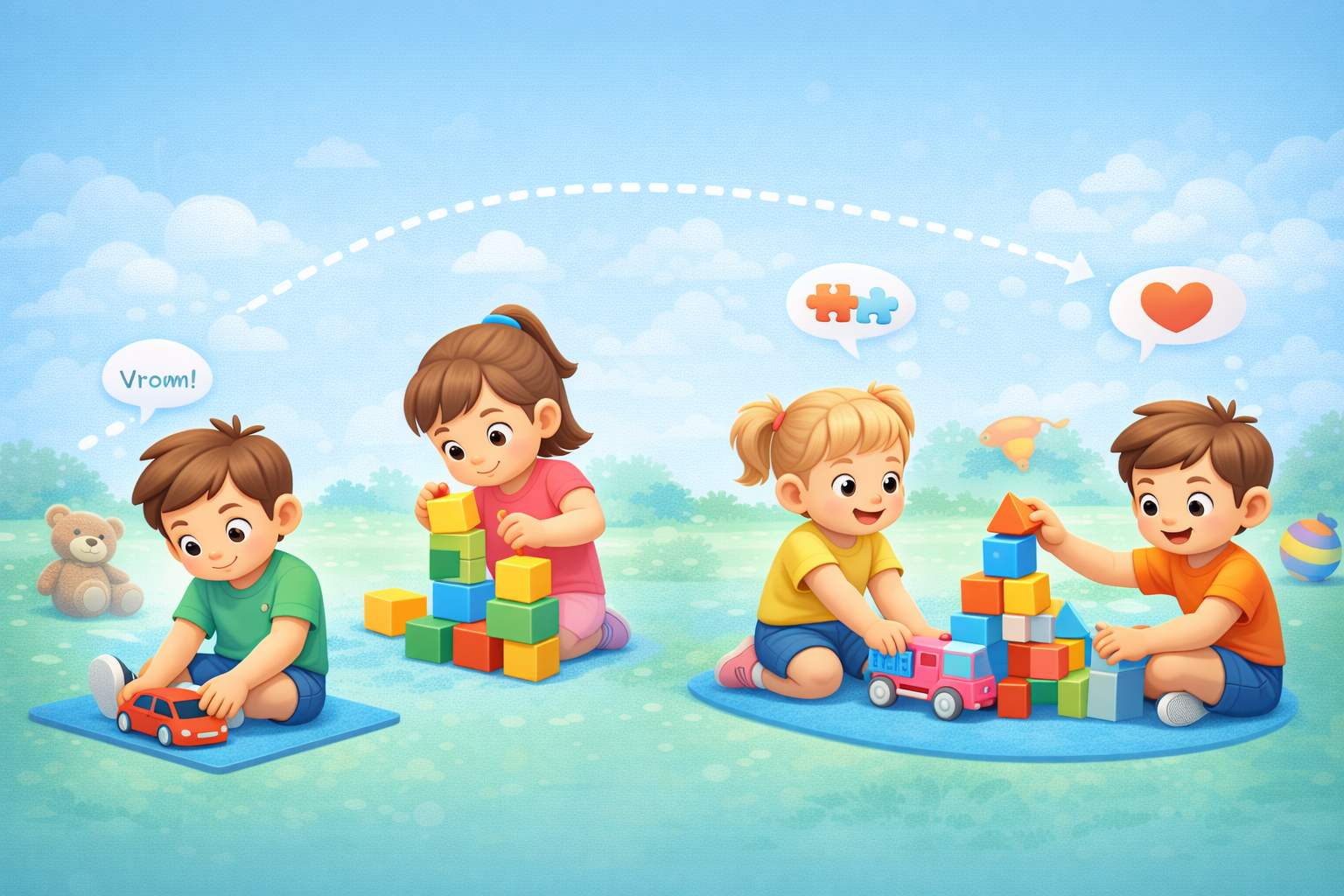
The child plays alone and is not interested in what others are doing.
- The Scene: A toddler sits with a pile of blocks, completely absorbed. Another child sits two feet away. They do not interact.
- Why it matters: This teaches independence and focus. Do not force them to play with others yet; they aren’t ready.
Stage 3: Onlooker Play (2 Years)
The child watches others play but doesn’t join in. They might ask questions (“What are you doing?”) but they stay on the sidelines.
- Parent Tip: Don’t push them to “go join in.” They are learning the rules of social interaction by watching. They are gathering data.
Stage 4: Parallel Play (2+ Years)
This is the classic toddler stage. Children play side-by-side with similar toys, but they do not play together.
- The Scene: Two kids are digging in a sand pit. They are both digging. They might mimic each other. But there is no common goal.
- The Myth: Parents often think this is “rude.” It’s not. It is the bridge to social connection. They are enjoying the company without the pressure of negotiation.
Stage 5: Associative Play (3 – 4 Years)
Now they start to interact. They are interested in the people more than the activity.
- The Scene: Kids are running around a playground. One says, “Follow me!” and they all run. There are no organized rules or teams, but they are talking and trading toys.
- The Challenge: This is where “sharing” conflicts start because they are finally interacting with the same objects.
Stage 6: Cooperative Play (4+ Years)
This is the advanced level. Play has a goal and rules.
- The Scene: “You be the doctor, I’ll be the sick puppy.” Or building a tower together where one kid fetches blocks and the other stacks.
- Skill Required: This requires negotiation, empathy, rule-following, and conflict resolution. It is hard work!
How to Support Each Stage at Little Land
Our gym is designed to accommodate all stages.
- For the Solitary Player: We have quiet sensory corners and individual fine motor stations.
- For the Parallel Player: The long foam pits or sand tables allow kids to be next to each other comfortably.
- For the Cooperative Player: The “Imagination Station” (grocery store, kitchen) forces kids to assign roles.
Is My Child Behind? Remember, these ages are averages. A tired or stressed 5-year-old might revert to Solitary Play to recharge. That is healthy. However, if your 4 or 5-year-old never acknowledges other children or seems unable to engage in even parallel play, it might be a sign to speak with a pediatric therapist. We can help bridge that gap, turning “me” play into “we” play.