
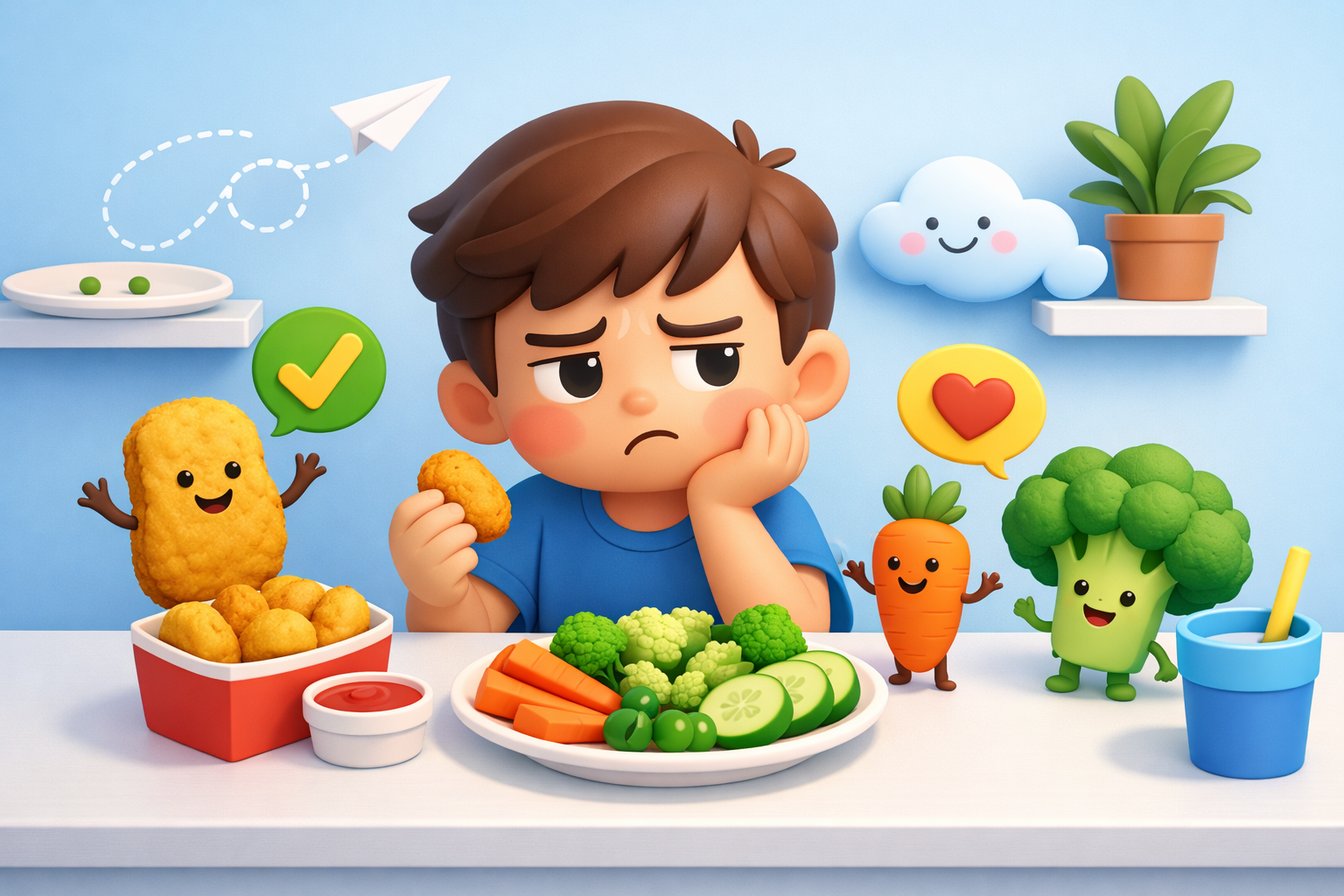

If you have a child who only eats “beige foods” (nuggets, fries, crackers, pasta), you know the panic. You worry about their nutrition. You dread the dinner table battles. You feel judged by the parent whose toddler is happily munching on broccoli.
First: Take a deep breath. Picky eating is incredibly common, and it is rarely a result of “bad parenting.” At Little Land, we often view picky eating through a sensory lens. Eating is the most complex sensory task we do. It involves sight, smell, touch, taste, and sound (crunch!) all at once.
If your child is a “picky eater,” they might actually be a “sensory defensive eater.” Here is a low-stress guide to expanding their menu.
Table of Contents
1. Understand the “Why” (The Beige Comfort)
Why do kids love chicken nuggets and crackers? Because they are predictable. A chicken nugget always tastes the same. It always has the same texture. A blueberry, on the other hand, is a gamble. Is it sweet? Sour? Mushy? Firm? That unpredictability is terrifying for a child with sensory sensitivities. Tip: Don’t shame the beige food. It is their “safe zone.” We want to expand the zone, not destroy it.
2. The “No Pressure” Rule
Research shows that pressure (“Two more bites or no dessert!”) actually kills appetite and increases stress hormones. When the brain is stressed, it shuts down digestion. Adopt the Division of Responsibility:
- Parent’s Job: Choose what is served, when it is served, and where.
- Child’s Job: Choose whether to eat it and how much.
Put one “safe food” (bread, fruit) on the plate alongside the new food. If they don’t eat the new food, say nothing. The exposure counts.
3. Play with Your Food
We were taught “don’t play with your food,” but for picky eaters, play is the bridge to eating. Before a child eats a new food, they need to interact with it.
- Step 1: Look at it.
- Step 2: Touch it. (Pok it with a fork, pick it up).
- Step 3: Smell it.
- Step 4: Kiss it. (Touch it to lips, then put it down).
- Step 5: Lick it.
- Step 6: Bite it.
Encourage games: “Can you stack the carrots like a tower?” “Can you make a mustache with the green beans?” Touching the food desensitizes the tactile system. It makes the food less scary.
4. The “Food Chaining” Method
Instead of jumping from nuggets to spinach (too big a leap!), use small steps called “Food Chaining.” Change one property at a time.
- Starting Point: Fast food chicken nugget.
- Step 1: Store-bought frozen nugget (different brand).
- Step 2: Homemade breaded chicken nugget (similar texture, different taste).
- Step 3: Breaded fish stick (similar look, different protein).
- Step 4: Grilled chicken strips.
5. Watch the Language
Avoid labeling your child: “He’s my picky eater.” Children internalize labels. Instead, use “growth mindset” language about food:
- Instead of “I don’t like it,” teach them to say “I’m still learning about this flavor.”
- “You don’t have to eat it, just keep it on your ‘learning plate’.”
When to Seek Help
Typical picky eating is normal. “Problem Feeding” is different. You should consult a pediatric therapist if your child:
- Eats fewer than 20 foods total.
- Drops a safe food and never picks it up again.
- Gags or vomits at the sight/smell of food.
- Is losing weight or not growing.
For most kids, mealtime peace comes when we stop the power struggle. Make the table a happy place, and eventually, the palate will follow.