
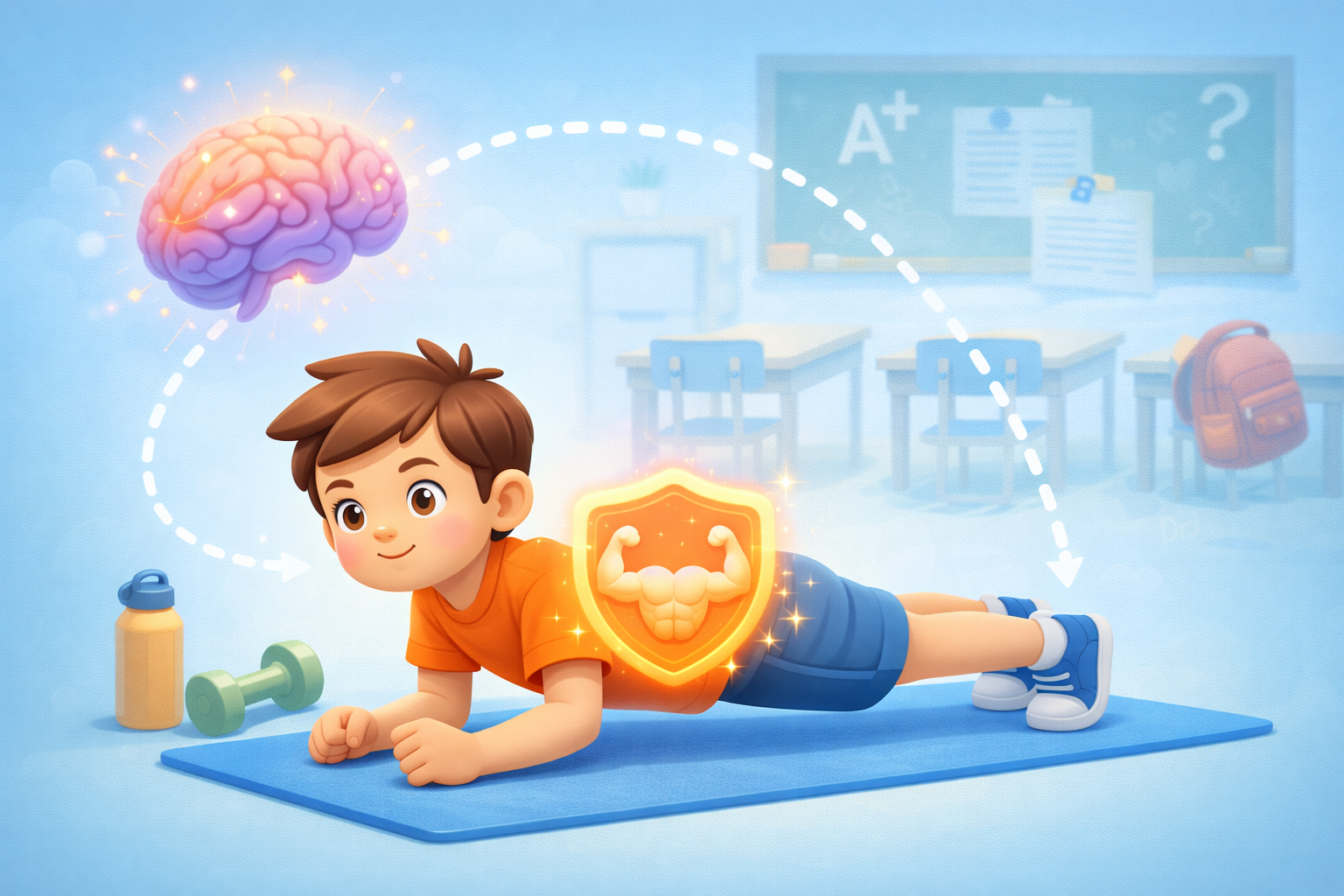
Core Strength in Kids: It’s About More Than Just Abs (and How It Affects Focus in Class)

When we hear “core strength,” we usually think of bodybuilders with six-pack abs or Pilates instructors. But for children, core strength is not about aesthetics. It is about stability.
Pediatric therapists have a saying: “Proximal stability leads to distal mobility.” Translation: You need a strong center (trunk/core) to have control over your edges (hands and feet).
If your child’s core is weak, they cannot control their fingers well enough to write, and they cannot sit upright long enough to listen.
The “Classroom Slump”
Have you ever seen a child practically melting into their desk at school? They lean their head on their hand, lay their chest on the table, or hook their feet around the chair legs. Teachers often label this as “lazy” or “bored.” In reality, this child is exhausted. Their core muscles are too weak to hold their spine up against gravity for six hours a day. They are using the desk or their hand to prop themselves up because their muscles have given up.
Why Core Strength Affects Handwriting
Try this experiment: Sit on a wobbly exercise ball and lift one leg. Now, try to thread a needle or write your signature neatly. It is really hard, right? When your center is unstable, your body stiffens your shoulders and arms to compensate. A child with a weak core often has a tense, tight grip on their pencil. They press too hard, break the lead, and complain that “writing hurts.” They are using their shoulder muscles to write because their core isn’t doing its job.
How to Test Your Child’s Core
You can try the Superman Pose test at home.
- Have your child lie on their tummy on the floor.
- Ask them to lift their arms (stretched out in front) and legs off the ground at the same time, balancing on their belly.
- See how long they can hold it.
- Result: A typical 7-year-old should be able to hold this for 20-30 seconds without trembling or collapsing. If they drop after 5 seconds, their core needs work.
Fun Ways to Build Core Strength
Sit-ups are boring. Play is better.
1. Wheelbarrow Walking Hold your child’s ankles and have them walk on their hands. This forces the core to engage to keep the back straight.
2. Climbing Climbing a ladder, a rock wall, or a rope is the ultimate core workout. It requires pulling the knees up and stabilizing the trunk.
3. Crab Walking Walking on hands and feet with the tummy facing the ceiling opens up the chest and strengthens the back muscles.
4. Swinging (pump it yourself!) Sitting on a swing and learning to “pump” the legs requires a massive amount of abdominal coordination.
5. Uneven Surfaces Walking on pillows, foam pits (like at Little Land), or balance beams forces the core micro-muscles to fire constantly to stay upright.
Building a strong core is the first step to building a strong student. Before we worry about their pencil grip, let’s make sure they have the strength to sit up in the chair.
 English
  Español de República Dominicana