
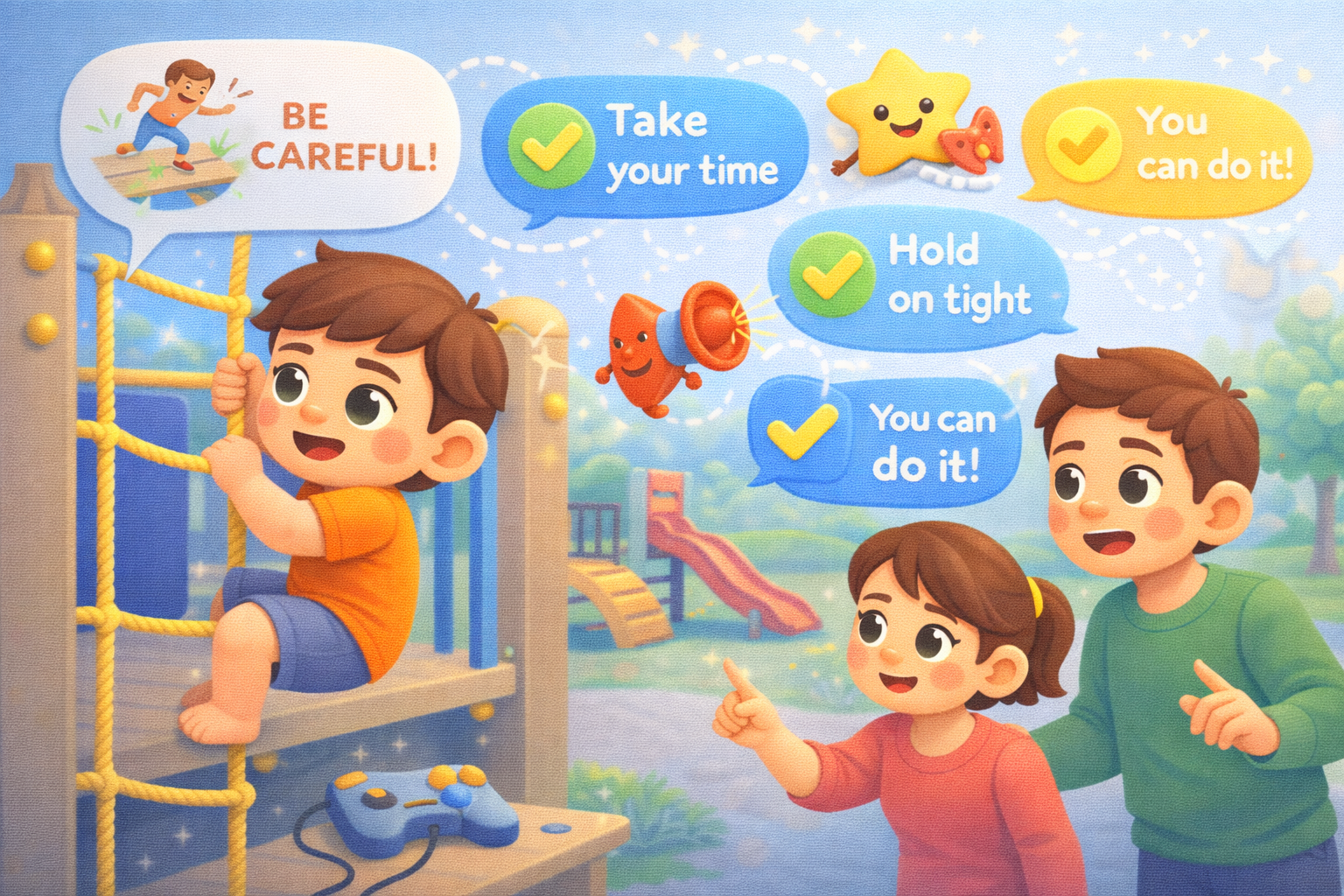

Go to any playground, and there is one phrase you will hear repeated like a mantra: “Be careful!” “Be careful!” “Watch out, be careful!”
We say it because we love our kids. We don’t want them to get hurt. But experts in child development and “Risky Play” suggest that the phrase “Be Careful” is not only ineffective, it might actually be harmful.
Why “Be Careful” Doesn’t Work
- It is Too Vague: What does “be careful” mean? Does it mean “slow down”? Does it mean “hold on tight”? Does it mean “look at your feet”? A child doesn’t know what action to take.
- It Induces Fear: Hearing “Be careful” constantly tells the child: The world is dangerous, and I am not capable of handling it. It breeds anxiety, not caution.
- It Becomes White Noise: If you say it every time they climb a ladder, they stop hearing it.
The Importance of Risky Play
Niños need to take risks. Climbing high, balancing on logs, and jumping off swings teaches them:
- Body Awareness: What can my body do?
- Risk Assessment: Is this too high? Can I make this jump?
- Resilience: If I fall, I can get back up. If we remove all risk (or hover over them nervously), they never learn to judge safety for themselves. They become accident-prone because they rely on you to tell them when to stop.
What to Say Instead
Our goal is to move from Managing them to Mentoring them. We want to draw their attention to the environment so they can make the decision.
1. To Increase Awareness:
- “Notice how slippery the rocks are because of the rain.”
- “Do you see where your foot is going?”
- “That branch looks thin. Does it feel strong?” These phrases force the child to pause and evaluate the situation themselves.
2. To Check In:
- “How does your body feel up there?”
- “Do you feel safe?”
- “What is your plan for getting down?” Asking “What is your plan?” is powerful. It engages their prefrontal cortex (problem-solving brain).
3. When It Is Actually Dangerous: If they are about to run into traffic or touch a hot stove, “Be careful” is too slow. Use direct commands.
- “STOP.”
- “Come down now.” Save the urgent voice for urgent situations.
Practical Example
Scenario: Your child is climbing a tall tree. Old Way: “Be careful! You’re going to fall! Get down!” (Child feels anxious or ignores you). New Way: “Wow, you are really high! I see you using your strong arms. Make sure you test the branches before you put your weight on them.” (Child feels capable but alert).
It takes practice to bite your tongue. The next time you want to shout “Be Careful,” take a breath. Look at the situation. Is there immediate danger? If not, try asking a question instead. You are building a child who trusts their own body, and that is the best safety gear they can wear.
 English
  Español de República Dominicana