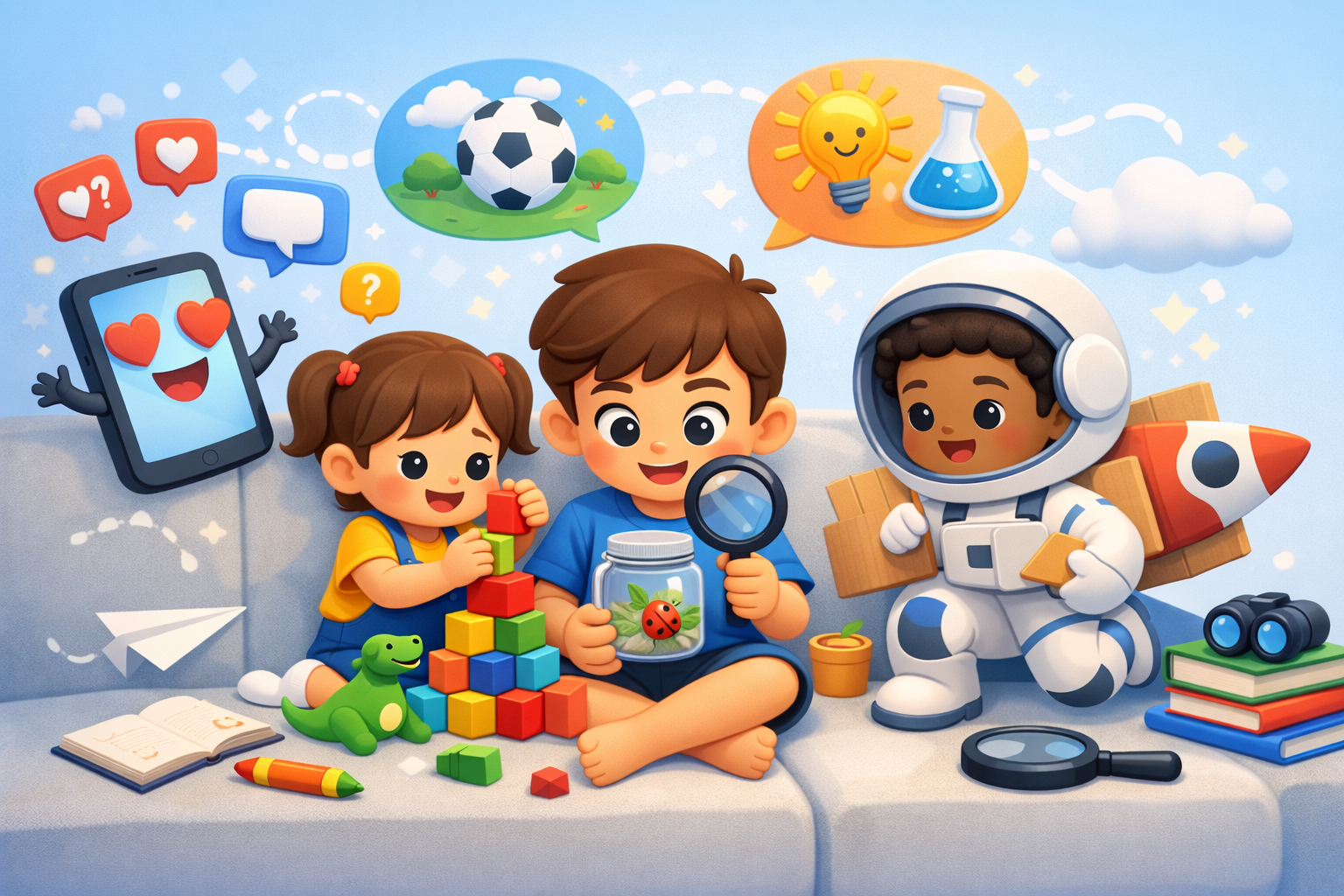

In a world of scheduled soccer practices, piano lessons, and rigorous academic tutoring, there is one critical activity that is slowly disappearing from our children’s schedules: Unstructured Play.
Many parents feel pressure to keep their children constantly “productive.” We worry that if they aren’t in a structured class, they aren’t learning. However, research into child psychology suggests the exact opposite. Unstructured, open-ended play is not just a way to pass the time; it is the primary engine of human development.
What is Unstructured Play?
Structured play has rules and a specific goal (e.g., a board game, a sports match, or following Lego instructions). Unstructured play, also known as “free play,” is child-led. There are no pre-set rules, no coaches, and no specific “right” way to do it.
Examples include building a fort out of cushions, pretending the floor is lava, or exploring a play gym at their own pace. In this environment, the child is the director, the scriptwriter, and the actor.
The Cognitive Benefits: Problem Solving
When a child is in a structured class, they look to the adult for the answer. In free play, they must solve problems themselves. Imagine a child trying to climb a foam obstacle course at Little Land. They put their foot in one spot, slip, and have to reassess. “Where do I put my hand? How do I balance my weight?” This trial-and-error process builds Executive Function, the brain’s ability to plan, focus attention, and juggle multiple tasks. No worksheet can teach physics and problem-solving as effectively as a child physically navigating a challenging environment.
The Social Benefits: Negotiation and Empathy
Have you ever watched a group of toddlers in a ball pit or a sandbox? It looks like chaos, but it is actually a complex social negotiation.
- “I want the blue bucket.”
- “No, I have it!”
- “Okay, we can trade?”
In unstructured environments, children must learn to read social cues, negotiate turns, and resolve conflicts without an adult immediately stepping in as a referee. These are the soft skills that determine future success in the workplace and relationships. They learn that if they are too aggressive, other kids won’t play with them. If they are kind, they make friends. This natural feedback loop is essential for emotional intelligence.
The Emotional Benefits: Confidence and Resilience
One of the key features of Little Land’s design is providing “safe risks.” Children need to take risks to build confidence. Jumping from a height that feels just a little bit scary, or balancing on a beam, allows a child to confront fear.
When they succeed, they feel a rush of competence. “I did it!” When they fail, they learn that failure isn’t the end of the world. They get up and try again. This builds resilience. In a structured environment where everything is safe-proofed and guided, children are often denied the dignity of risk, which can lead to anxiety later in life.
How Little Land Facilitates Open Play
At Little Land, our facility is intentionally designed to support this type of growth. Unlike an arcade where play is passive (pushing buttons), our gym encourages active exploration.
- Sensory Equipment: Stimulates the brain.
- Open Spaces: Encourages running and social games.
- Fine Motor Stations: Allows for quiet, focused creativity.
We believe that children are natural scientists. Their laboratory is the playground. By giving them the time and space to engage in unstructured play, we aren’t just letting them “burn off energy”, we are giving them the freedom to build their brains, their bodies, and their characters.
So, the next time you see your child inventing a strange game with no apparent rules, don’t interrupt. Watch them. You are witnessing the serious business of learning in action.
 English
  Español de República Dominicana