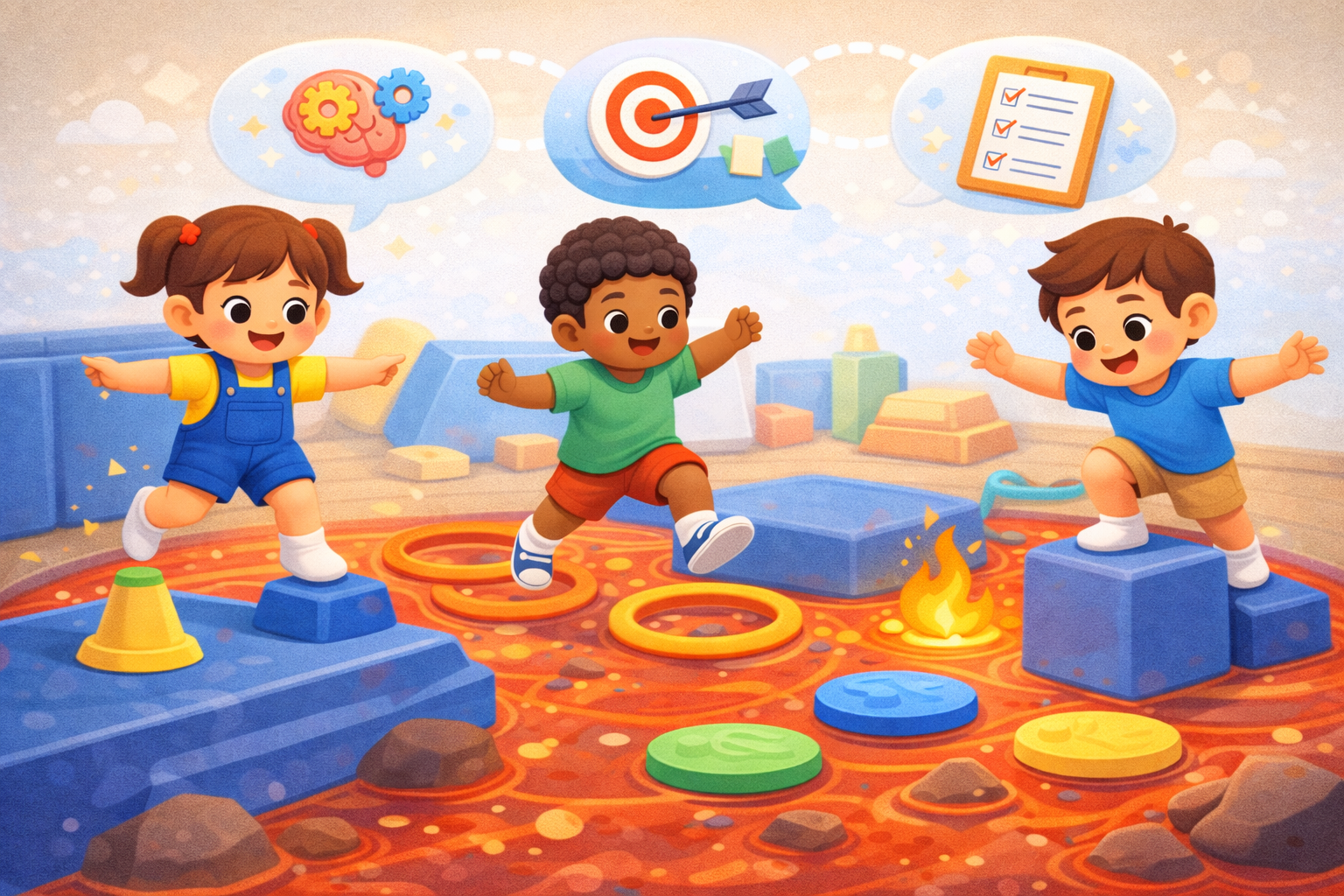

“Don’t touch the floor! It’s hot lava!” We have all played it. Leaping from the couch to the coffee table, balancing on a pillow, clinging to the doorframe. It feels like pure adrenaline fun. But neurologically, navigating an obstacle course (real or imaginary) is a heavy workout for the brain’s frontal lobe.
It specifically targets Executive Function. Executive Function is the “Air Traffic Control” system of the brain. It allows us to filter distractions, prioritize tasks, set goals, and control impulses. Here is how a simple obstacle course builds these critical school skills.
1. Working Memory (Holding the Map)
To complete a course, the child must remember a sequence. “First crawl under the chair, then jump over the rope, then tag the wall.” They have to hold this multi-step instruction in their head while moving their body. In the classroom, this translates to: “Get your pencil, write your name, and open to page 5.” A child with weak working memory forgets step 2 by the time they finish step 1. Obstacle courses practice this retention in a fun way.
2. Inhibition (Stopping on a Dime)
In “The Floor is Lava,” the rule is: Don’t touch the ground. The child wants to put their foot down to steady themselves, but they have to inhibit that impulse. This is Impulse Control. It is the same brain muscle used to not shout out the answer in class, or to not hit a sibling when angry. Physical inhibition leads to emotional inhibition.
3. Motor Planning (Problem Solving)
“How do I get from this beanbag to that chair? It’s too far to jump.” The child has to simulate the movement in their mind before doing it. “Maybe if I stretch my leg… no, I’ll fall. Maybe I can drag the blanket over.” This is real-time problem solving. It requires assessing risk, judging distance (spatial awareness), and adapting the plan if it fails.
4. Cognitive Flexibility (Shifting Gears)
What happens if the pillow slips? The plan is ruined. The child has to adjust immediately without having a meltdown. They have to be flexible. “Okay, the pillow is gone. I’ll use the cushion instead.” This resilience, the ability to pivot when things go wrong, is a key life skill.
Creating Courses at Home (or at Little Land)
You don’t need fancy equipment.
- Under: Crawl under a table.
- Over: Jump over a line of tape.
- Through: Crawl through a cardboard box tunnel.
- Balance: Walk along a strip of painter’s tape on the floor.
At Little Land, our structures are essentially giant, safe, permanent obstacle courses. The rock walls, monkey bars, and foam pits provide the perfect environment to challenge a child’s motor planning. When a child conquers a course, they aren’t just exhausted (which is a bonus for bedtime!); they are proving to themselves that they can set a goal, figure out the path, and reach the finish line.
 English
  Español de República Dominicana