
Crossing the Midline: The Brain-Body Connection Essential for Reading and Writing

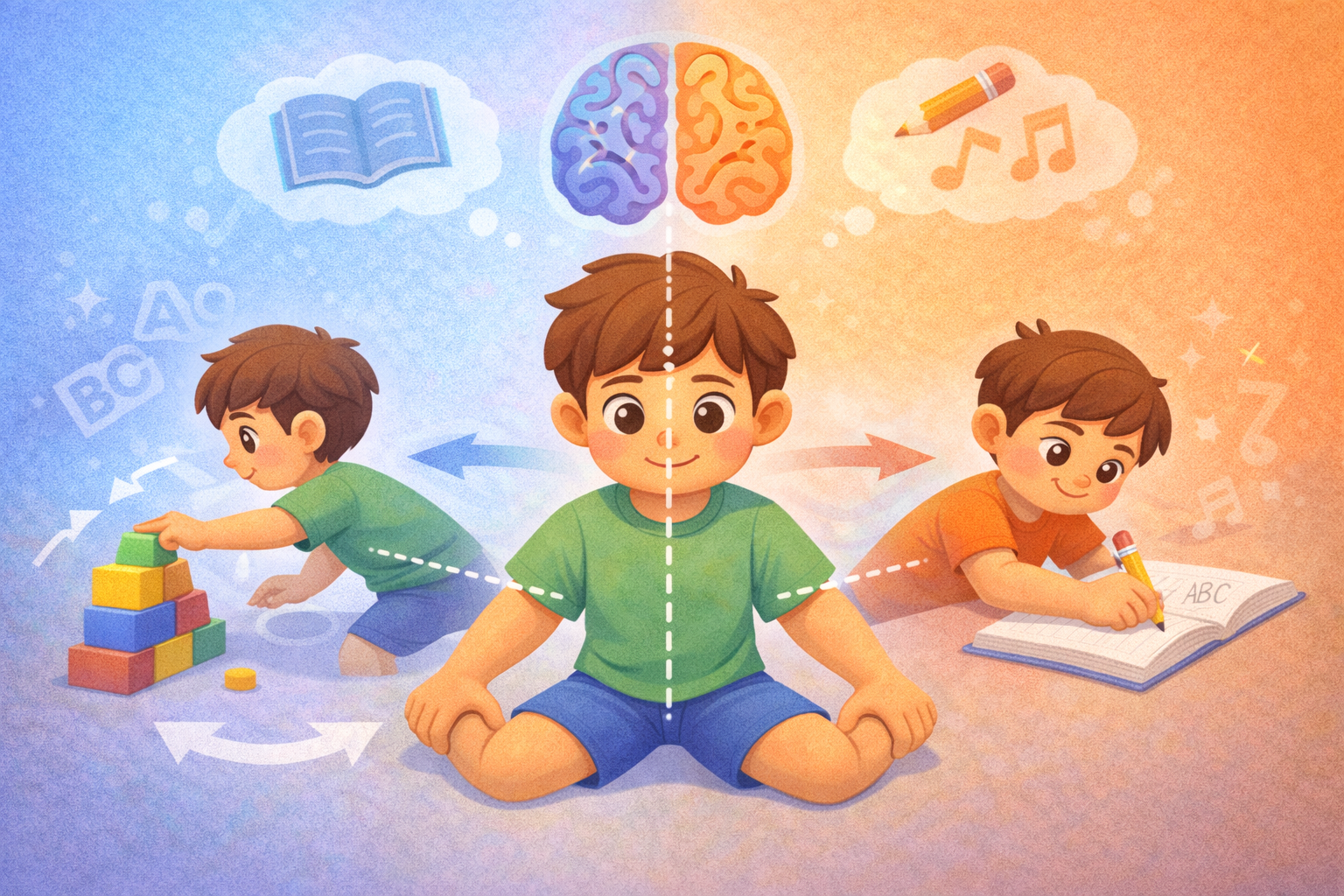
Imagine drawing a horizontal line across a piece of paper. Now, imagine a vertical line going down the center of your child’s body, from the top of their head to between their feet. This invisible line is called the Midline.
“Crossing the Midline” refers to the ability to reach across this invisible line with an arm or leg to perform a task on the opposite side of the body. For example, using your right hand to scratch your left shoulder.
It sounds simple. We do it hundreds of times a day without thinking. But for a developing child, this is a complex neurological skill that requires the left and right sides of the brain to talk to each other.
Table of Contents
Why Is It So Important?
The brain is divided into two hemispheres. The left side controls the right side of the body, and vice versa. Connecting these two sides is a bridge of nerve fibers called the Corpus Callosum. When a child crosses the midline, they are strengthening this bridge. If they cannot cross the midline easily, the two sides of the brain aren’t communicating efficiently. This leads to specific learning struggles.
1. Reading Issues To read a sentence, your eyes must track from the left side of the page to the right side. They must cross the midline. A child who struggles with this might lose their place in the middle of the sentence or skip words because their eyes get “stuck” at the midline.
2. Handwriting Struggles When writing, a child needs to write across the page from left to right. If they avoid crossing the midline, you might see them:
- Switch the pencil from the right hand to the left hand when they reach the middle of the paper.
- Shift their entire body in the chair so they don’t have to reach across. This halts the flow of writing and makes handwriting messy and exhausting.
3. Self-Care Delays Putting on socks and shoes requires using both hands across the body.
Signs Your Child Is Stuck
Watch your child play. Do they:
- Kick a ball only with the foot on that side?
- Pick up a toy on their left side with their left hand, even if they are right-handed?
- Rotate their trunk excessively to avoid reaching across?
Exercises to Help Cross the Midline
The good news is that you can strengthen this brain bridge through play.
1. The Infinity Loop (Figure 8) Draw a large “Figure 8” on a chalkboard or a piece of paper taped to the wall. The “8” should be lying on its side (like the infinity symbol). Have your child trace it with their finger or a crayon continuously. The key is to keep their belly button facing forward so their arm must cross the center.
2. Washing the Car (or Windows) Give them a big sponge. Ask them to make huge circles to wash the car or a sliding glass door. Encourage them to use one hand to wash the entire area, reaching all the way to the far side without moving their feet.
3. Cross-Crawls (Marching) Have them march in place. Ask them to touch their right hand to their left knee, then left hand to right knee. Do this slowly. It requires balance and coordination.
4. Sticker Tag Put a sticker on their left shoulder and ask them to peel it off with their right hand.
5. Windmill Stretches Stand with feet apart. Bend over and touch the right hand to the left foot, then stand up. Repeat on the other side.
At Little Land, our equipment is designed to force these movements naturally. Reaching for a hold on the rock wall or navigating the obstacle course requires constant midline crossing. By integrating these movements into play, we are literally wiring the brain for future academic success.
 English
  Español de República Dominicana