
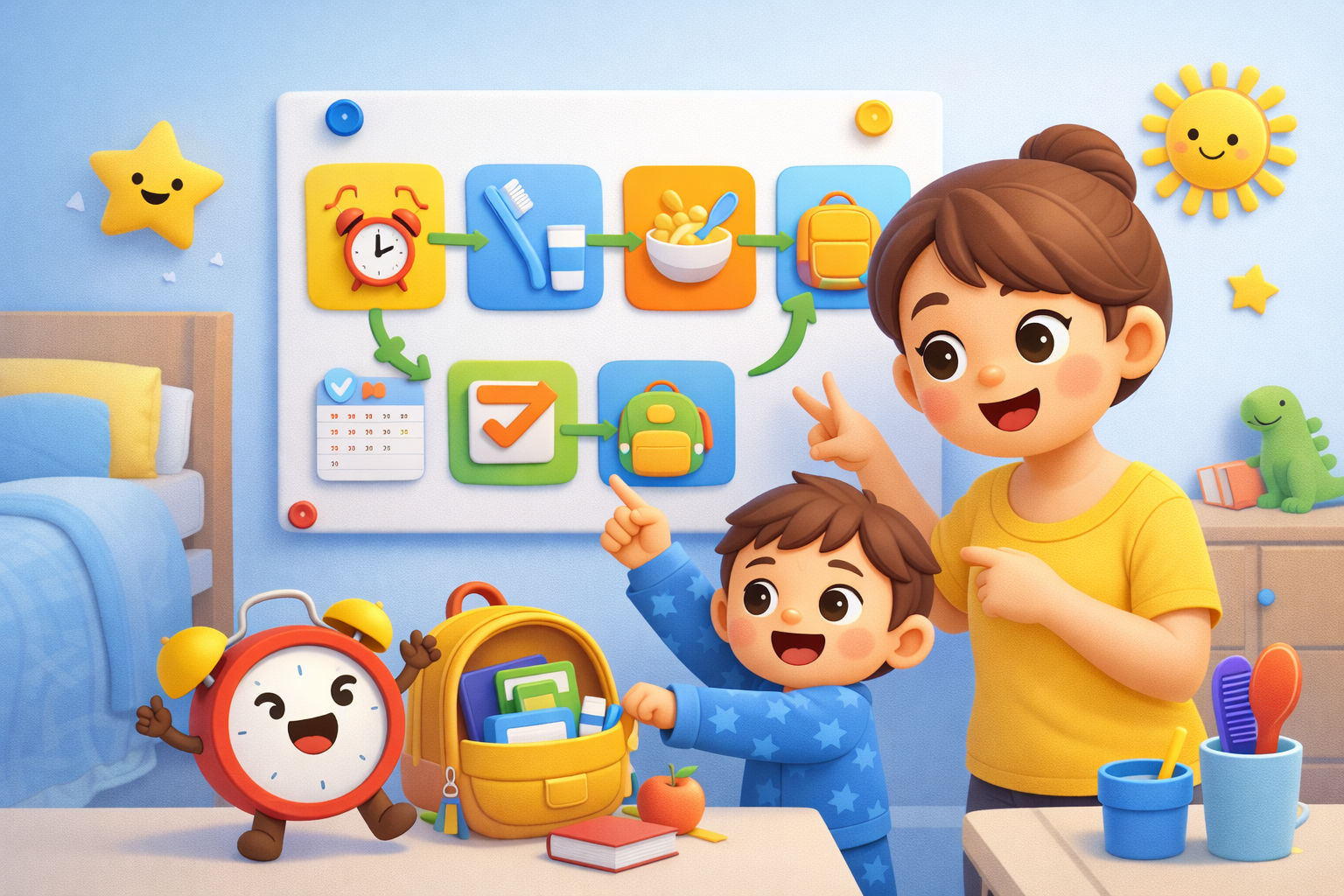

“Put on your shoes.” “Where are your shoes?” “Why are you holding a Lego? I said put on your shoes!”
Table of Contents
If this sounds like the soundtrack of your mornings, you are not alone. The “morning rush” is universally stressful. Parents are fighting against the clock to get to work or school, while children seem to be moving in slow motion, distracted by every speck of dust on the floor.
Before you label your child as “lazy” or “defiant,” it is important to understand the brain science behind the delay. Young children have not yet developed Executive Function, the brain’s management system responsible for planning, prioritizing, and understanding time.
Asking a 5-year-old to “get ready for school” is like asking them to fly a plane. It is too vague and involves too many invisible steps. The solution? Stop talking and start showing. Enter the Visual Schedule.
Why Visuals Work Better Than Words
Auditory processing (listening to instructions) is the last sense to fully develop. When you shout instructions from the kitchen, your child’s brain often filters it out as background noise, especially if they are hyper-focused on a toy. Visuals are static. They don’t disappear like words do. A picture of a toothbrush stays there, reminding the child of the task without you having to nag.
How to Create a Schedule That Works
You don’t need to be an artist. Stick figures or clipart work perfectly.
- Break It Down: specific tasks. Instead of “Get Ready,” break it into: Potty -> Brush Teeth -> Get Dressed -> Eat Breakfast -> Shoes On.
- Make It Interactive: This is key. The child needs to physically engage with the schedule. Use Velcro dots, magnets, or a “flap” system. Moving a picture from the “To Do” column to the “Done” column gives a hit of dopamine (satisfaction).
- Keep It Simple: Do not include 20 steps. Start with the 4-5 essential tasks.
The “Time Blindness” Hack
Children have “time blindness.” Telling them “we leave in 10 minutes” means nothing because they don’t feel the passage of time.
- Use a Visual Timer: A timer that shows a red disk disappearing gives a concrete representation of how much time is left.
- Music Playlists: Create a “Morning Playlist” of 3 songs.
- Song 1: Get dressed.
- Song 2: Eat breakfast.
- Song 3: Shoes on. When “Happy” by Pharrell comes on, they know it is shoe time.
Preparation: The Night Before
The battle is often won or lost the night before. Decision fatigue in the morning causes meltdowns.
- Outfit Choice: Let them choose their clothes before bed. Once chosen, they are locked in. No changing minds at 7:00 AM.
- The “Launch Pad”: Designate a box or hook by the door. Backpack, shoes, and coat go there. Always.
Be Consistent
The goal is to turn the routine into muscle memory. If the schedule says “Teeth then Breakfast,” do it that way every single day. Eventually, the child’s body will move to the sink automatically without you having to say a word. By handing over the responsibility to the schedule (“What does the picture say comes next?”), you stop being the “bad guy” and start being the coach.
 English
  Español de República Dominicana