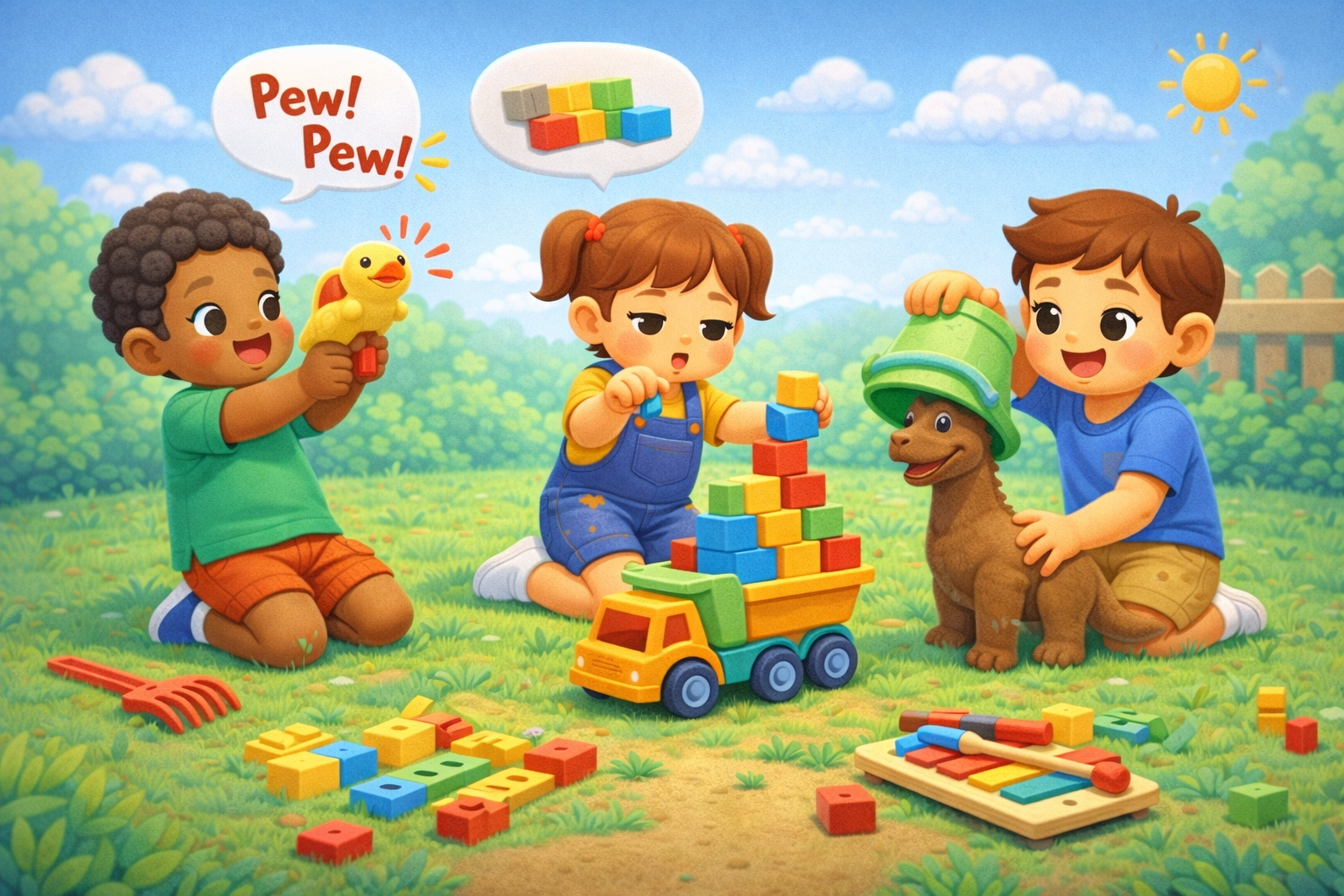

You buy your child a toy kitchen set. It comes with plastic food, pots, and pans. Five minutes later, you walk in. Your child is wearing the pot on their head like a helmet. They are using the plastic carrot as a drumstick to bang on the oven door. Your instinct might be to correct them. “No, honey, the pot goes on the stove. And carrots are for eating, not banging.”
Table of Contents
Wait. Before you correct them, ask yourself: Are they hurting anyone? Are they breaking the toy? If the answer is no, let them play. Using a toy in a way it wasn’t intended is not “wrong.” It is a sign of Cognitive Flexibility.
What is Cognitive Flexibility?
It is the ability to shift thinking and adapt to new situations. It is the ability to see that one object can have multiple meanings.
- Convergent Thinking: Using a toy exactly as the instructions say (Following the rules).
- Divergent Thinking: Using a toy in a new, unexpected way (Breaking the rules to create something new). We need both, but traditional schooling focuses heavily on Convergent Thinking (there is one right answer). Play is the only place where Divergent Thinking truly thrives.
The “Schema” Shift
When a child puts a pot on their head, they are testing a Schema (a mental category).
- Old Schema: Pots are for cooking.
- New Schema: Pots are hard, hollow objects that fit on heads. Therefore, pots can be hats/helmets. They are expanding their understanding of the physical properties of the object. They are being scientists.
Why We Correct Them (The Adult Bias)
Adults suffer from Functional Fixedness. We only see objects for their intended use. A chair is for sitting. A fork is for eating. Kids don’t have this bias yet. To them, a chair is a mountain. A fork is a comb (hello, Little Mermaid!). When we constantly correct them, “That’s not how you use that”, we are training them to have Functional Fixedness. We are killing their creativity.
Safety First, Then Freedom
Obviously, boundaries exist.
- If they are using a toy golf club to hit the TV -> Stop them. (Safety/Property Damage).
- If they are using a puzzle piece as a “cookie” for their doll -> Let them.
How to Encourage “Wrong” Play
1. The “What Else?” Game Pick up a random object, like a wooden spoon. Ask: “I know this is a spoon, but what ELSE could it be?”
- A microphone?
- A magic wand?
- A guitar? See how many ideas you can come up with.
2. Mix the Toy Sets Don’t keep the dinosaurs separate from the dollhouse. Let the T-Rex have tea with Barbie. Mixing categories forces the brain to make new connections.So, if you see your child sliding down the slide at Little Land head first (safely) or climbing up the slide instead of down, don’t rush to correct the “rules.” They are experimenting with gravity and friction. As long as it is safe, playing the “wrong” way is actually the right way to learn.
 English
  Español de República Dominicana