
Fine Motor Skills 101: Why the ‘Pincer Grasp’ Matters for Your Child’s Future Handwriting

When we think about a child’s development, we often look at the big milestones: walking, running, and jumping. These are Gross Motor Skills. But there is a smaller, quieter set of skills that is just as important for your child’s independence and academic success: Fine Motor Skills.
Specifically, there is one tiny movement that therapists obsess over: The Pincer Grasp.
Table of Contents
What is the Pincer Grasp?
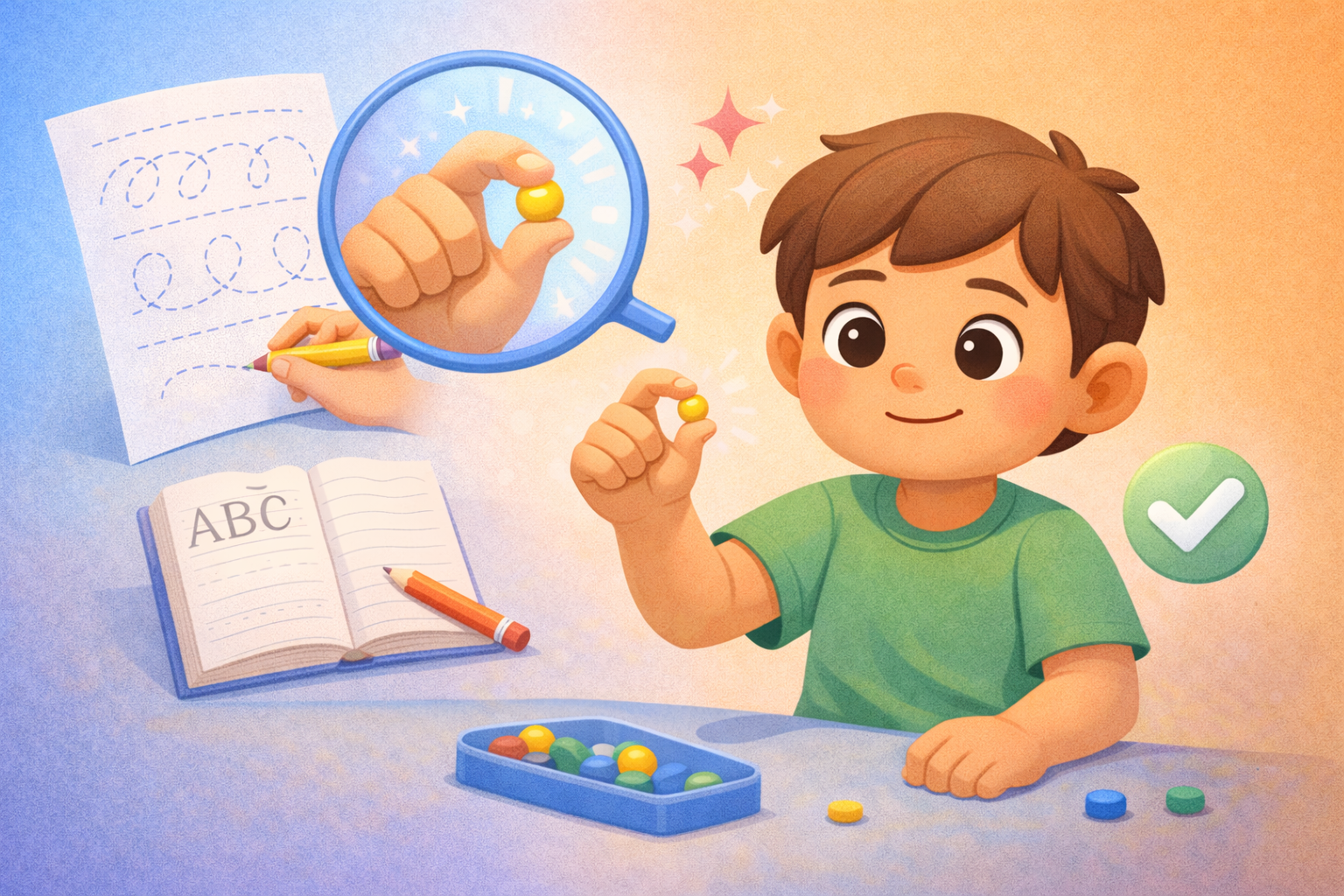
The pincer grasp is the ability to hold a small object using only the tip of the thumb and the tip of the index finger (pointer finger). Before a baby develops this (usually around 9-12 months), they use a “raking grasp,” using their whole hand to scoop up Cheerios. The transition to using just two fingers is a massive neurological leap.
Why Is It So Important?
You might think, “So what if they pick up food with their whole hand?” The pincer grasp is the foundation for almost every tool a human uses.
- Self-Feeding: It allows a child to pick up a pea, a raisin, or a piece of cheese independently.
- Dressing: Zippers, buttons, and snaps all require a strong pincer grasp.
- Writing: This is the big one. The standard tripod grip used for holding a pencil is essentially an advanced version of the pincer grasp. If a child’s thumb and index finger are weak, they will struggle to hold a pencil, leading to messy handwriting, hand fatigue, and a dislike of drawing or writing.
Stages of Development
- Cruising (8-9 months): Using the side of the thumb and the side of the index finger (Inferior Pincer Grasp).
- Mastery (10-12 months): Using the very tips of the thumb and index finger, forming a perfect “O” shape (Superior Pincer Grasp).
Signs of Fine Motor Weakness
If your preschooler or toddler avoids coloring, gets frustrated with buttons, or switches hands constantly while drawing, they might have weak fine motor muscles. At Little Land, we often see kids who have great gross motor skills (they can run fast!) but struggle with the “fiddly” tasks. This is because modern childhood often involves more swiping (tablets) than pinching (play-doh).
Fun Ways to strengthen the Pincer Grasp at Home
You don’t need boring drills. Strengthening these muscles should be play!
1. The “Sticker Peeling” Game Peeling a sticker off a sheet requires precise pincer work. Let your child cover a piece of paper (or themselves!) in stickers.
2. Q-Tip Painting Instead of a big paintbrush, give your child Q-tips to paint with. The thin stick forces them to use their fingertips rather than a fist grip.
3. Tongs and Tweezers Create a “feeding station” for a toy animal. Have your child use kitchen tongs or large tweezers to move pom-poms or cotton balls into a bowl. This mimics the opening and closing motion of scissors too.
4. Pipe Cleaner Colander Take a kitchen colander (strainer) and give your child pipe cleaners. Ask them to thread the pipe cleaners through the tiny holes. This requires immense focus and steady fingers.
5. Play-Doh “Pinch Pot” Make a ball of Play-Doh and ask your child to pinch around the edges to make a pizza crust or a bowl. The resistance of the clay builds muscle strength in the hand arch.
The Bottom Line
In a world of touchscreens, the art of the pincer grasp is at risk of being underdeveloped. By encouraging activities that require pinching, poking, and threading, you are literally preparing your child’s hands for the first day of school. If you are concerned about your child’s dexterity, our therapists at Little Land can assess their grip and provide fun, targeted activities to get those fingers moving.

 English
  Español de República Dominicana