
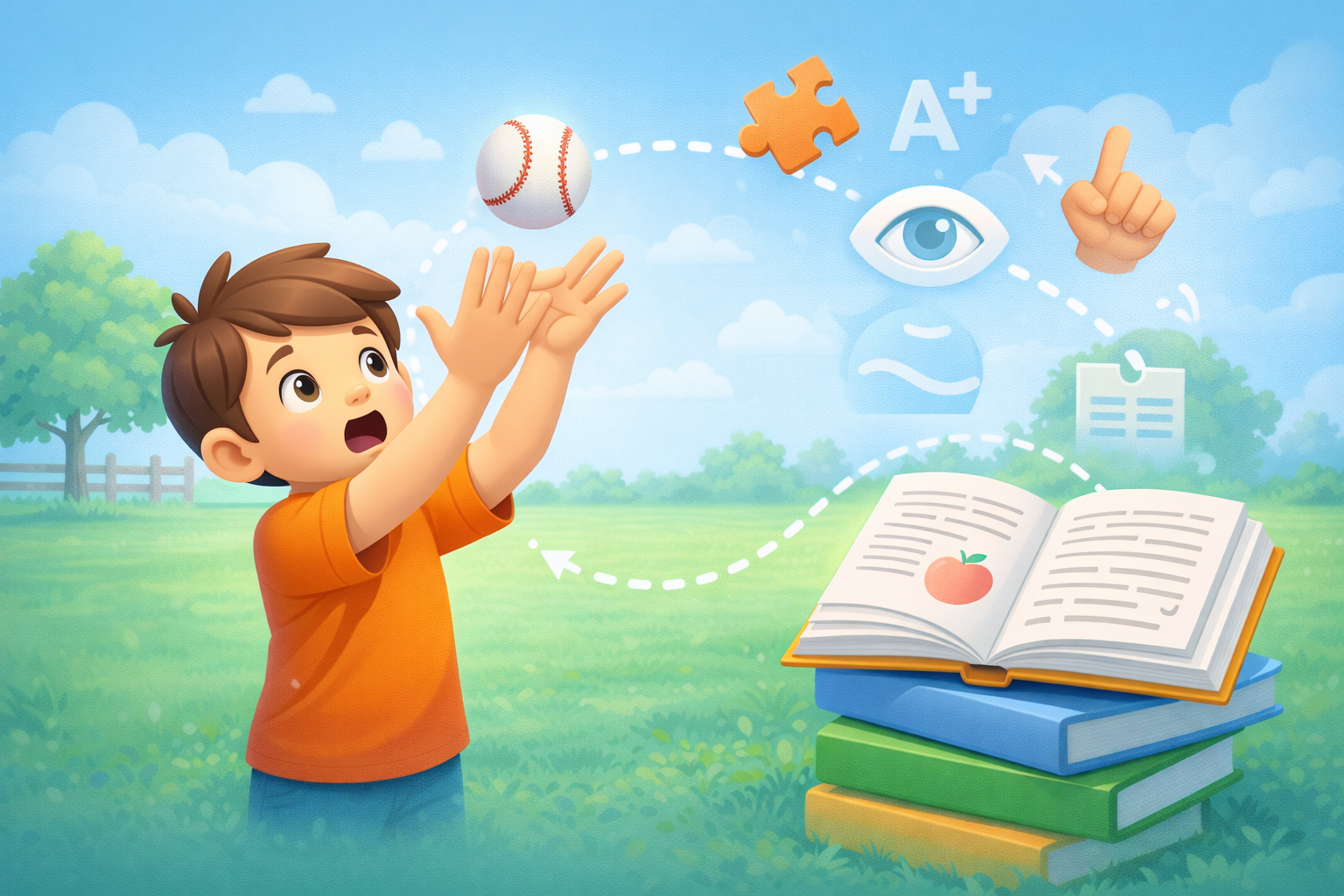

If your child is struggling to read, your first instinct is probably to buy more books or hire a reading tutor. But what if the problem isn’t their intelligence? What if the problem is their eyes, and specifically, how their eyes talk to their hands?
This skill is called Visual Motor Integration (VMI), often referred to as eye-hand coordination.
While we often associate eye-hand coordination with sports (catching a baseball), it is actually the foundational skill for the classroom. In fact, up to 80% of what a child learns in school requires the visual system.
Table of Contents
What is VMI?
VMI is the ability to interpret visual information and respond with a motor action.
- Visual Perception: “I see a circle.”
- Motor Coordination: “I will move my hand.”
- Integration: “I will use my hand to draw a circle that matches what I see.”
The Classroom Disconnect
Let’s look at a typical school task: Copying from the Board. To do this successfully, a child must:
- Look at the distant board (Visual focus).
- Remember the shape of the letters (Visual memory).
- Look down at the paper (Visual tracking).
- Tell their hand to reproduce those shapes (Motor planning).
- Ensure the letters stay within the lines (Spatial awareness).
If a child has poor VMI, this process is agonizingly slow. By the time they have copied the first word, the teacher has erased the board or moved on.
Signs of VMI Struggles
- Bad Handwriting: Letters are different sizes, float above the line, or are reversed (writing ‘b’ instead of ‘d’).
- The “Clumsy” Cutter: Struggles to use scissors to cut along a line.
- Dislikes Puzzles: Cannot figure out how shapes fit together.
- Difficulty Tying Shoes: Cannot translate what they see (the loops) into what their fingers need to do.
How to Strengthen VMI Through Play
The best way to improve VMI is not more worksheets. It is getting the eyes and hands to work together in 3D space.
1. Balloon Volleyball Balloons move slowly, giving the child’s brain time to process the visual information and plan the hand movement to hit it back. This is excellent for beginners.
2. Maze Games Whether on paper or a physical walking maze, navigating a path requires looking ahead and adjusting movement.
3. “I Spy” with a Flashlight Turn off the lights. Use a flashlight to point at objects in the room. Ask the child to “catch” your light beam with their own flashlight. This trains Visual Tracking.
4. Cutting Dough Before cutting paper, let them cut snakes made of Play-Doh. It offers resistance and feedback.
5. Catch and Throw Start with a large beach ball (easier to see and catch) and move to a tennis ball (requires precise timing).
At Little Land, our play structures are designed to challenge VMI constantly. When a child reaches for a monkey bar, they are calculating distance (visual) and gripping (motor). When they step on a balance beam, they are watching their feet. By improving these physical skills, we often see a ripple effect in the classroom: handwriting gets neater, reading speeds up, and confidence soars.
 English
  Español de República Dominicana